Lab Overview

Research at μNOEL

The Micro & Nano Opto-Electronics Laboratory (μNOEL) at Seoul National University studies light emission, absorption, resonance, and mode control in engineered micro- and nanoscale photonic structures. Our research focuses on photonic-crystal-based phenomena and their applications to lasers, light-management structures, and high-efficiency optoelectronic devices.

Research Highlights

Resonant cavity phosphor testing
Application-driven researchQuantum dotPhosphorResonant cavity

Resonant-Cavity-Enhanced Nanophosphors

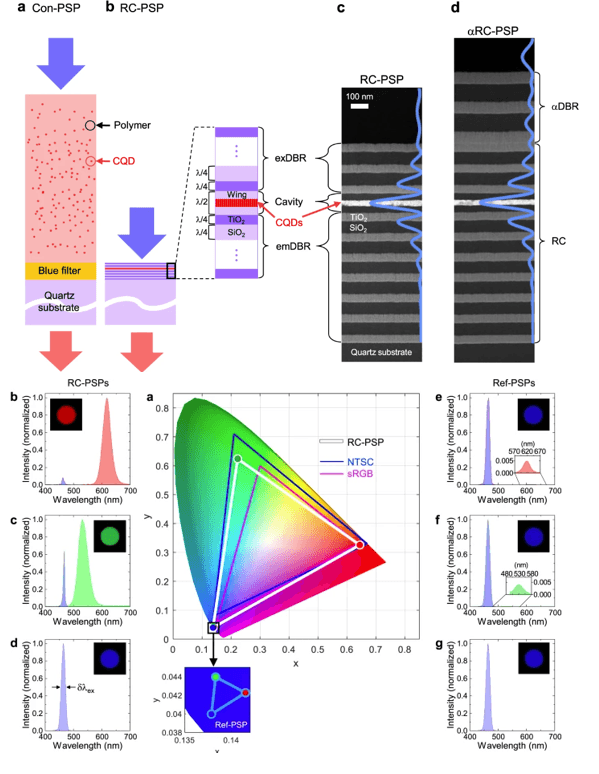
Colloidal quantum dots integrated with resonant photonic structures create high-efficiency color-conversion phosphors for next-generation display and lighting platforms.

  • Hybrid platforms combining quantum dots and photonic resonators
  • Boosted emission brightness via resonant cavity enhancement
  • Color conversion tailored for microdisplay and lighting systems
DMD-based maskless lithography station
Process developmentNanofabricationLithographyDMD

High-Throughput Maskless Nanofabrication

DMD-based digital lithography establishes a rapid, cost-effective path to fabricate submicron photonic structures without masks, dramatically boosting process throughput.

  • Maskless patterning with digital micromirror device (DMD) projection
  • Submicron resolution delivered at high wafer-level productivity
  • Process recipes benchmarked against electron-beam lithography
Topological nanocavity visualization
In-depth studyTopological photonicsPhotonic crystalNanolasers

Hierarchical Topological States in 2D Photonic Crystals

Topologically engineered photonic crystal lattices support hierarchical eigenstates?including bulk, edge, and corner modes?that exhibit robustness against structural imperfections. By controlling multipole interference and symmetry in InGaAsP photonic-crystal slabs, these multidimensional states can be selectively excited for stable light confinement and lasing.

  • 2D bulk, 1D edge, and 0D corner eigenstates coexisting in a single photonic crystal platform
  • Robust confinement enabled by topologically controlled mode distributions
  • Reliable lasing behavior across multiple dimensional eigenstates for integrated nanophotonic devices
Disorder-enabled random laser platform
Prototype devicesRandom laserDisorderNonlinear optics

Disorder-Based Random Lasers

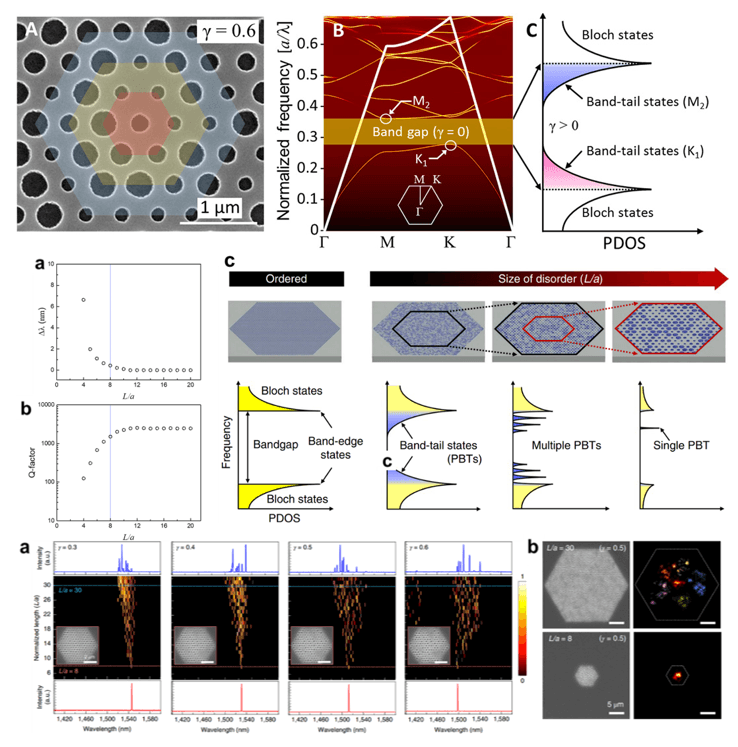
Engineered disorder in photonic crystals supplies non-periodic optical feedback that supports tunable random lasers with controllable spectra, directionality, and mode competition.

  • Disordered photonic crystal backbones form distributed feedback paths
  • Control over multimode behavior, emission direction, and spectral shaping
  • Active tuning of lasing thresholds and dynamics via structural disorder